Austin Weird
11 years ago
 November, thanksgiving cooking with grandma...
 October, Halloween and Olivia's 2nd birthday!....
Late Summer Baptism for Anna... June rings in our new home....
 May finds The Brownells with a new family member...
 Dad and Anna...
 2009
2009
How will I remember 2009?
I will remember 2009 well. We are very fortunate and I am very thankful for all the great things in our life recently. It is now Christmas morning, and I am wondering how I am going to get home in an hour...several nurses who got off earlier had to turn around and come back and sleep at the hospital! No way I'm not getting home to spend Christmas morning with my girls though, even if I get stuck and have to walk!
So I shall say farewell to you for now. My resolution to myself in front of those few of you that read this meager blog: I will crank it up a little in 2010. I know a couple of you check in from time to time and read up on my blathering. I am excited to make my 2009 MUSIC post. I had some great finds this year and will make a "Peltgrande's Top Ten Songs of 2009" post soon.
 Last weekend I got a great chance to go to East Lansing and see the Hawkeyes play the MSU Spartans. I have to say, I was more than a little worried heading in there.
 I had a benefit of a sideline pass, and a great Canon lens borrowed from a friend. My photography skills and then posting the pics on a blog don't do justice to document the game, but I will share what I got. I still ended up with some pretty great pics, and the benefit of watching the whole game literally on the sideline with the players. And now that we all know the outcome, it's one of those games where someday I will reminisce...."I was there"....
 The Spartan fans were ready to rock. Not just the jocks, but the Star Wars nerds like myself donned their war gear and showed up to watch The Spartans take on the Undefeated #6 Iowa Hawkeyes.
 We started with the ball, (surprise!). The game started like many of our games so far this year, trading punches to the jaw. Holding our ground and weathering the initial rush of emotion from the crowd and home team environment.
  Here's Sparty! Ok, I love Herky, but Sparty is pretty damn cool. He's been in some great commercials and is the first non-athlete to grace the cover of NCAA Football, (Wii edition, 2009). During half time Jon Thorburn and I went upstairs to get some hot chocolate and in a very surreal moment Sparty walked on to the elevator with us. I felt like I was in an ESPN commercial riding up to the Press Box with Sparty.
 Adrian Clayborn and the defense showed up to play.
 I went to the end zone for some pics for Brandon Wegher returning.
 I really like this pic. Brandon Wegher waiting for and wanting the ball while 75,000 Spartan fans cheer against him.
 Ummm, sadly this is where I would curl up in the fetal position.
 D-Line chomping the bit to feast on some Spartan.
 Hunter and Binns
 I had to look this guy up. Next man in.
 Ferentz and staff watching the D-Line hold MSU to a field goal.

 More pics of the offense. I really like the last one just above with CL Rocker in focus. He gave us fits all night, and almost got away with a defensive holding that would have ended the game for The Hawks.
 Ballard lays out Cousins just after the throw.
 The Defense walking up to the line.....
 ....while Cousins gets ready to make a play. The stadium was rocking. Chants of "Go Green!...Go White!" back and forth every time a timeout was called or Iowa touched the ball. MSU drives....hook and ladder to Blair White? No! With 1:37 left in the game MSU takes the lead, 13-9 a few plays later with none other than Blair White catching a pass in the end zone.
 Stanzi and Vandenburg discussing the play just before the drive down the field.
 I grabbed this last pic before I put my camera away so I could just cheer on The Hawks the last few plays of the game. As you know, with goal-to-go, Iowa used every second and down, coverting the 4th down play to Marvin McNutt for the winning touchdown. We went nuts. The crowd went silent. An unbelievable moment. It may not have been the 1985 field goal, or Tate to Holloway, but it was certainly special. An ending every Hawkeye fan will remember for years to come, marking history as The University of Iowa Hawkeyes move to 8-0 for the first time. Ever.


 8-0
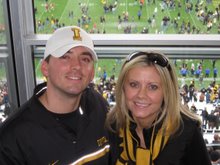
8-0 A happy Peltgrande after the game. It's great to be a Hawkeye!

 BERLIN (Reuters) - A fox has been unmasked as the mystery thief of more than 100 shoes in the small western German town of Foehren, authorities said Friday.